
January 29, 2026
.png)
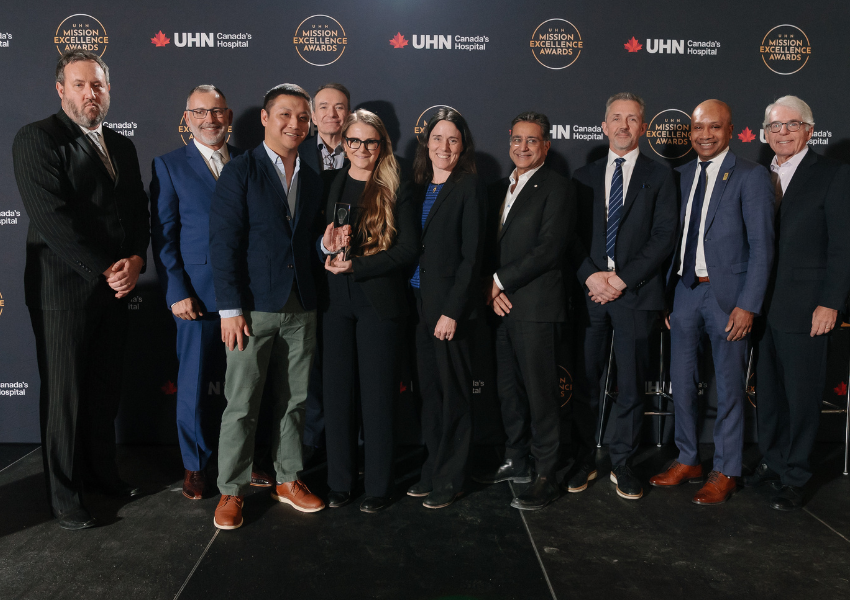
L to R: H.A.L.O. Clinical Co-Founders, Marijana Zubrinic and Dr. Shaf Keshavjee, Chief of Innovation, UHN; Dr. Pamela Ohashi, Senior Scientist, UHN's Princess Margaret Cancer Centre
At this year’s UHN Mission Excellence Awards, Inventor of the Year Award recipients Dr. Pamela Ohashi and Team H.A.L.O. were recognized for advancing cancer research and delivering a scalable patient safety solution now used across Canada.
Dr. Pamela Ohashi was recognized as Inventor of the Year for research still underway—the discovery of a gamma delta T‑cell receptor that opens a new line of inquiry in cancer immunotherapy and continues to be evaluated for its clinical potential.
Team H.A.L.O. was honoured for an innovation already implemented in clinical care. H.A.L.O., a virtual observation system now standard of care at UHN, is already embedded in day‑to‑day practice, helping reduce falls and support patient safety. Its spread to more than 30 sites across Canada demonstrates what happens when an idea is tested, refined, and sustained in real clinical environments.
Congratulations to Dr. Pamela Ohashi, named the newest winner of the 2025 Mission of Excellence Inventor of the Year (Individual) Award! Dr. Ohashi is being recognized for her discovery of a new version of a gamma delta (γδ) T-cell receptor that helps the immune system recognize and fight cancer, with exciting potential for broad cancer treatment.
A recognized leader in the area of cancer immunology, Dr. Ohashi is a Senior Scientist at UHN’s Princess Margaret Cancer Centre and Director of its Tumor Immunotherapy Program. Her work has demonstrated the true spirit of the Inventor of the Year Award—by advancing a novel scientific discovery with a clear pathway toward patient impact through commercialization.
About the Invention
According to the Canadian Cancer Society, nearly two in five Canadians are expected to develop cancer in their lifetime—making the discovery and advancement of new treatment strategies acritical priority.
Immunotherapy harnesses the body’s immune system to recognize and destroy cancer cells. While this approach has transformed cancer care, one of its major challenges remains the limited number of known treatment targets that can be safely and broadly exploited across different tumor types.
Dr. Ohashi and her team identified a specific gamma delta (γδ) T-cell receptor in a patient whose tumour was eliminated following immunotherapy. This receptor is also unique in its ability to recognize multiple cancer types without requiring a close genetic match between the treatment and the patient.
Building on this finding, the team showed that this receptor could be introduced into immune cells to help guide them in recognizing cancer—laying the groundwork for exploring new approaches to cell-based cancer therapies. Because this receptor can recognize cancer without requiring a close genetic match to the patient, it has the potential to be developed into treatments that could benefit a broader group of patients.
“Cloned from a patient who had a complete response to immunotherapy, this new gamma delta T-cell receptor is different than anything used in current T-cell therapies, and gives us an exciting new option for patients living with this disease,” explains Dr. Ohashi. “This could make cell therapy far more accessible to patients with cancers like lung, melanoma, ovarian and others, where further treatment options are critically needed.
“This discovery was only possible because of the extraordinary teams in UHN’s Tumor Immunotherapy Program and the INSPIRE clinical trial, and I extend deep thanks to them,” she adds.
Backed by promising early research and demonstrated activity across multiple tumour types that have limited treatment options, this discovery represents an important step toward expanding the reach and impact of immune-based cancer therapies.
Meanwhile, Dr. Ohashi and her team continue to diligently conduct additional research to better understand how this receptor works and how it may be translated into new therapeutic approaches.
“While further experiments will uncover exactly what the gamma delta T-cell receptor is recognizing, we’re excited that it is already demonstrating promise over traditional approaches,” says Dr. Ohashi. “This has the potential to be an off-the-shelf therapeutic platform, easier to mass-produce and more widely applicable to many patients.”
Interdisciplinary group is the first to win UHN’s Mission of Excellence Team Inventor of the Year Award. They are being awarded for creating and launching patient monitoring innovation H.A.L.O. (Human Attended Live Observation)
Congratulations to the winners:
H.A.L.O. clinical inventors and co-founders, Dr. Shaf Keshavjee and Marijana Zubrinic
TECHNA engineering and software teams, led by Dr. Luke Brzozowski and Jimmy Qiu
Altum Health team led by Shiran Isaacksz, Justin Young, Emily Hannon and Lori Seeton
A category within UHN’s prestigious Mission of Excellence Awards and sponsored by Commercialization at UHN, the Inventor of the Year Award recognizes an individual or team whose invention has made a substantial and noteworthy commercialization contribution leading to A Healthier World. This year’s team recipients are recognized for their collaborative efforts to transform the care and safety of high-risk patients in Canadian hospitals through the invention, development and scaling of the H.A.L.O. continuous monitoring solution.
Brought to life through a passionate, hospital-wide collaboration of inventors, engineers, technical experts and business leaders, H.A.L.O. had successfully launched as a fully operational company in early 2025. It now offers a robust, much-needed virtual care clinical service beyond the UHN family of hospitals, where it has been deployed across 50inpatient units realizing significant efficiencies and cost savings.
The Origins of H.A.L.O. – An Innovation Inspired by Need
The inspiring commercialization journey of H.A.L.O. began not in a lab or research facility, but directly at the patient’s bedside, thanks to the steadfast vision and dedication of both Marijana Zubrinic, Nurse Practitioner at UHN’s Toronto General Hospital, and Dr. Shaf Keshavjee, UHN’s former Surgeon in Chief. Marijana’s work involved caring for patients awaiting lung transplantation, often with complex respiratory needs and needing constant observation due to high safety risks. After witnessing several preventable serious safety events, Marijana committed herself to inventing and developing a solution to a very real problem facing vulnerable patients.
The Challenge
Across hospital settings, patients experiencing delirium, confusion, or dementia may act impulsively and may engage in behaviours that place their safety at risk, potentially resulting in significant harm. These patients may intentionally or unintentionally remove essential medical equipment—such as oxygen masks—or attempt to get out of bed without assistance, increasing the risk of falls, injury, and other preventable adverse events.
In 2015,recognizing the urgency of this challenge in a particularly vulnerable patient population, Marijana Zubrinic and her colleagues in Toronto General Hospital’s Thoracic Surgery Division began piloting a novel approach to remotely monitor high-risk patients, starting with those awaiting lung transplantation.
The Invention
“The first attempt was a simple make-shift device consisting of a camera and speaker on an IV pole donated from the OR & Biomedical Department, with monitoring provided by nursing summer students,” explains Zubrinic. “A stable, yet admittedly bored, pre-lung transplant patient was excited at the prospect of being involved in our initial proof of concept. Two days into the experiment, it saved his life.”
Prior to discharge, the patient thanked Zubrinic for involving him in the pilot, and asked her to promise to make the invention a standard of care across Canada.
“I made that promise,” explained Zubrinic, “And from there, the project quickly evolved from a good idea into an impactful project that every nurse and physician in the division was deeply vested in, particularly my co-inventor and H.A.L.O. co-founder Dr. Shaf Keshavjee.”
By the time the COVID-19 pandemic hit, the pair’s telemonitoring solution was beginning to be widely used across all UHN hospital sites – ready to support increasing volumes of critical patients and balance the workload of overstretched frontline staff.
The Evolution of H.A.L.O.
Over the last decade, ongoing advancements in in software, hardware and clinical protocols transformed H.A.L.O into a comprehensive virtual sitting solution that now includes*:
· H.A.L.O. Device: a two-way audio-visual device placed next to the patient’s bedside. The device itself has a privacy shield to support patient dignity and privacy
· H.A.L.O. Workforce: a live, secure video feed is streamed from the device to H.A.L.O’s patient observation centre in the MaRS Heritage Building, which is staffed 24/7/365 by a team of 30+ ‘patient safety observers’
· H.A.L.O. Software: patient safety observers use H.A.L.O’s proprietary technology to vigilantly observe vulnerable patients and have the benefit of AI powered enhancements such as detecting motion, observer alertness and offering night vision
When a potential safety risk is observed, the safety observers provide gentle redirection by speaking to patients directly via the H.A.L.O. system, and if needed, escalate concerns to bedside nursing staff. This approach helps extend the care team’s reach while allowing nurses to remain focused on delivering direct, high-priority patient care.
Taking H.A.L.O. from Bedside to Canada-wide
Realizing H.A.L.O.’s potential to address significant challenges in Canadian hospitals and care settings, a commercialization pathway emerged, drawing on UHN’s internal expertise and resources. TECHNA led the system design and engineering development across hardware and software to turn a bedside prototype into a dependable, scalable platform, while Altum Health provided the operational and business structure needed to create a viable commercial opportunity and accelerate H.A.L.O.’s go-to-market timeline. Transforming H.A.L.O. into a scalable, market-ready solution required focused incubation, dedicated infrastructure, and a broader team of engineering and business experts—including those at TECHNA and Altum Health—who together turned H.A.L.O. into a mighty “invention on steroids.”
In Spring of 2025, the enhanced H.A.L.O. patient safety innovation became the foundational platform for a separate business venture that continues to gain momentum across Canada.
Today, H.A.L.O. has been deployed in 24 hospitals and six long-term care (LTC) facilities across Ontario, Manitoba and Newfoundland – supporting nearly 6,000 patients and enabling almost one million hours of remote observation. The results are even more impressive, including decreased mortality among hospitalized patients awaiting lung transplantation, reduced falls, increased patient/family and staff satisfaction, operational enhancements and cost savings for hospitals and LTC facilities.
For patients and their families, peace of mind is one of the leading benefits of the H.A.L.O. continuous monitoring solution.
In December 2025, as Glenn Totton’s wife Heather awaited a double lung transplant at Toronto General Hospital, her health continued to deteriorate.
“While the nursing staff are wonderful and attentive, and I tried to be by Heather’s beside to keep an eye on her oxygen levels, no one can be present at all times,” explains Glenn, who temporarily relocated with Heather from New Brunswick in anticipation of her transplant. “Knowing the H.A.L.O. technology was in the room gave us a great deal of peace of mind. For example, if Heather and I became engaged in a conversation, the H.A.L.O. technician would gently remind her to put on her oxygen mask. It was so reassuring to know that someone was constantly looking out for her.”
The Potential for Groundbreaking Innovation is Everywhere
Reflecting on the team’s receipt of the prestigious Inventor of the Year Award, Zubrinic offers words of encouragement and inspiration for all members of the UHN team.
“Often, nurses and front line staff don't think that they're capable of invention. The truth is, innovation can happen anywhere within a hospital – especially at the patient’s bedside where we can observe care gaps and opportunities.”
“From that very first patient, I promised I wouldn’t stop until every hospital in Canada had access to this solution,” she adds. “That promise drives everything we do at H.A.L.O., and we’re just getting started.”
*Provided by H.A.L.O. Telemonitoring Inc.
